
What Load Cells Are, How They Work, and Where They're Used
In industries where tension, load, and force measurement are part of daily operations, understanding how loads behave is essential. Load cells sit at the center of that understanding. They provide the data that operators rely on to prevent overload conditions, verify performance, stay in compliance with industry regulations, and maintain safe and efficient systems. This guide walks through the fundamentals of load cells, addressing what they are, how they work, and the most common types used in the field. It also addresses a reality many operations face: standard solutions don’t always fit.
What Is a Load Cell?
A load cell is a sensor designed to measure force and convert it into an electrical signal that can be monitored, displayed, or integrated into a control system. Whether that force is applied in tension, compression, or shear, the underlying goal is to translate a physical load into usable data. In practice, load cells are rarely standalone devices. They are typically part of a broader system that allows operators to observe loads in real time, log performance data, or automate responses when thresholds are reached. From overhead cranes to marine deck machinery, their role is foundational.
How Load Cells Work
At a functional level, load cells measure strain; they rely on the simple principle that physical materials will deform under force. Strain is defined as the ratio of the change in length compared to the original unstressed length. The most common types of strain are identified as bending, axial, shear, and torsional. When a force is applied, the internal structure of the load cell, otherwise referred to as the elastic element, experiences a very small amount of deformation. This deformation is not visible to the naked eye, but it is enough to be measured. This deformation is the change in length mentioned above. Bonded to this element are components called “strain gages,” which respond to that deformation by changing electrical resistance. When the force is applied to the elastic member, the bonded strain gage elongates or shortens, thus changing the resistance of the gage. Think of a wire: if you stretch it the cross sectional area will decrease and thus the resistance increases. Those changes are captured within a full Wheatstone bridge circuit, a collection of 4 separate gages connected together, which converts the change in resistance into a measurable voltage signal. This is a typical configuration for sensors in our market. That signal, once calibrated, directly corresponds to the applied force. The process happens continuously and almost instantaneously, enabling real-time monitoring even in dynamic systems.
The Role of Strain Gages
Strain gages are the sensing backbone of most modern load cells. Typically manufactured as thin metallic foil arranged in a precise pattern, they are bonded directly to the surface of the load-bearing element. As that surface stretches or compresses under load, the geometry of the gage changes, which in turn alters its electrical resistance. Historically, they consist of a resistive element, made from Constantan alloy foil, and a carrier made from Polyimide or Kapton. Other material types are also sometimes used. What makes strain gages so effective is their sensitivity; they can detect extremely small changes in strain, allowing load cells to measure forces that range from a few pounds to hundreds of tons with a high degree of precision. 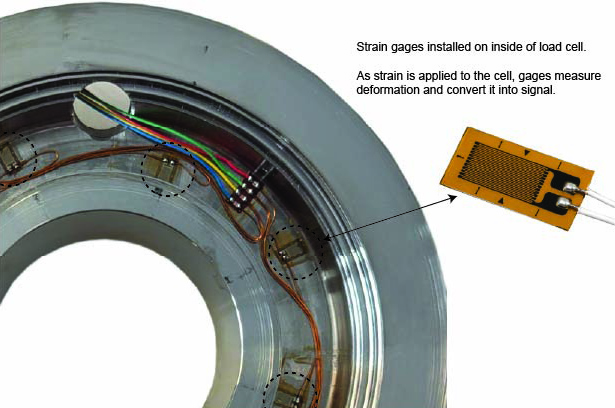
Understanding the Different Types of Load Cells
While the underlying measurement principle is consistent, load cells are manufactured in a variety of forms to suit different mechanical and environmental conditions. Choosing the correct type is less about preference and more about how and where the force is applied.
Load Pins
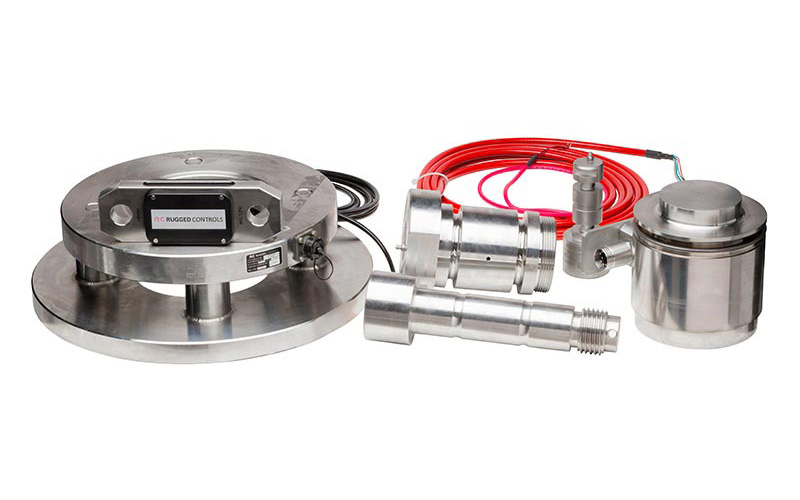
Load pins are among the most common solutions for measuring force within existing mechanical systems. By integrating sensing capability directly into a structural pin, they allow force to be measured without altering the nature of the equipment. This makes them particularly useful in sheaves, shackles, and pivot points for either new or retrofit use-cases. In real-world applications, load pins are rarely one-size-fits-all. Variations in diameter, length, material requirements, and environmental exposure often make standard designs impractical. As a result, custom load pins are frequently developed to match the exact specifications of the application, ensuring both mechanical compatibility and reliable measurement. Each load pin is designed to fit the receiving bearing within a high tolerance. Rugged Controls specializes in designing custom load pins and load monitoring systems for a wide range of applications and equipment compatibilities.
Compression Load Cells
Compression load cells are designed to measure forces that push down on the sensor. They are commonly installed beneath structures such as tanks or heavy equipment where the load is transferred vertically through the cell. Because these applications often involve substantial weight, compression cells are built to handle high capacities while maintaining stability over time. Their designs, whether pancake, canister, or column, reflect the need to distribute force evenly and minimize measurement error. They can be configured to measure both compression and tension.
Tension Links
Tension links, sometimes referred to as load links, are used when force needs to be measured in a straight-line pull. Installed directly in-line with the load path, they are a common sight in lifting and rigging operations. Their appeal lies in their simplicity. They can often be installed quickly, removed easily, and used across multiple applications. They are typically installed at a dead end of the rigging line. For operations that require flexibility or temporary measurement, tension links provide a straightforward solution.
Shear Beam Load Cells
Shear beam load cells operate by measuring the deformation caused by shear forces rather than direct tension or compression. They are widely used in platform scales and conveyor systems, where loads are applied across a surface rather than at a single point. One of their key advantages is stability. Shear beam designs tend to be more tolerant of minor misalignments and side forces, making them well-suited for environments where perfect loading conditions are difficult to maintain.
Why Force Direction and Deflection Matter
Load cells are engineered to measure force along a specific axis, and their accuracy depends heavily on maintaining that alignment. When forces are applied off-axis, such as through side loading or bending, the resulting measurements can become unreliable. It is important to make sure that the structures that the force sensor is being coupled to are robust enough. Beyond accuracy concerns, improper loading can also introduce long-term mechanical stress that shortens the lifespan of the sensor, causes the sensor to drift electrically, and prevents the sensors from maintaining accurate calibration. For that reason, installation is just as important as product selection. Ensuring that the load path is properly aligned with the intended measurement axis is critical to achieving consistent and dependable results.
What Load Cells Are Made Of
Although designs vary, most load cells share a common internal structure, ideally made from one piece of material stock typically of a high-strength material. Rugged Controls typically uses 17-4 stainless steel but can provide other material types if higher safety factors are required. At the center of the load cell is the elastic element, which is the section of the sensor that is machined to a known thickness to allow the metal to deform under load. This is where the strain gages are bonded to the metal forming the sensing layer, and thus measuring the strain. These gages are then wired into a full bridge circuit and connected to instrumentation that measures a voltage change per applied strain. The entire strain gage cavity is coated and potted to protect the gages from environmental factors like moisture and dust. Additional features like temperature compensation and signal conditioning are incorporated to improve performance in challenging conditions.
Accuracy in Real-World Conditions
Load cell accuracy is often expressed as a percentage of full scale, but that number only tells part of the story. While many load cells are rated within ±0.1% to ±0.25% of full scale, actual performance depends on how the sensor is installed and used. Factors such as temperature variation, mechanical alignment, and calibration practices all play a role in determining real-world accuracy. In many cases, repeatability, meaning the ability to produce consistent readings under the same conditions, is just as important as absolute precision.
Where Load Cells Are Used
Load cells are used anywhere force or weight needs to be measured or controlled. In crane and hoist operations, they help prevent overload conditions and verify safe lifting practices. In winch systems, they provide insight into line tension, allowing operators to manage loads more effectively. Industrial weighing applications rely on them to monitor materials in tanks and silos, while offshore and marine environments use them to track forces in mooring and anchoring systems. Despite the variety of applications, the underlying requirement is consistent: accurate, reliable measurement in conditions that are often far from ideal.
When Standard Solutions Fall Short
In theory, selecting a load cell should be straightforward: match the capacity, choose the appropriate type, and install it correctly. In practice, it is rarely that simple. Many applications involve constraints that standard load cells cannot accommodate. Space limitations, non-standard geometries, extreme environmental conditions, and highly dynamic loading scenarios all introduce challenges that require a more tailored approach. This is where custom load pins and engineered load monitoring systems become essential. By designing the sensing solution around the application, rather than forcing the application to fit the sensor, it becomes possible to achieve accurate measurement without compromising mechanical integrity or operational performance.
Final Thoughts
Load cells are often treated as simple measurement devices, but their impact extends far beyond basic data collection. They influence safety, efficiency, and decision-making across a wide range of industries. Understanding how they work, and just as importantly, recognizing their limitations, is key to selecting the right solution. As systems become more specialized, the ability to implement custom load measurement approaches is no longer a luxury; it is often the difference between a system that merely functions and one that works reliably with precision.
